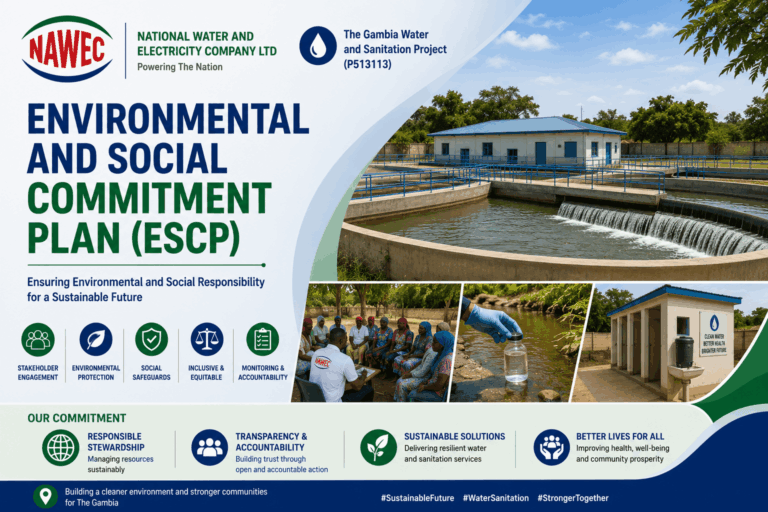
As part of its binding obligations under the World Bank Environmental and Social Framework, NAWEC discloses the final ESCP for the Gambia Water and Sanitation Project — a legally binding commitment to responsible, accountable, and inclusive project delivery.
The National Water and Electricity Company (NAWEC), through its Project Implementation Unit (PIU) under the Ministry of Petroleum, Energy and Mines (MOPEM), today publishes the final Environmental and Social Commitment Plan (ESCP) for the Gambia Water and Sanitation Project (GWASAP, P513113), financed by the World Bank’s International Development Association.
The ESCP is a legally binding component of the financing agreement between the Republic of The Gambia and the IDA. It sets out all material measures, actions, timelines, and institutional responsibilities that the Government — through NAWEC’s PIU — must carry out to ensure the project is implemented in full compliance with the World Bank’s Environmental and Social Standards (ESSs). The disclosure of this document reflects NAWEC’s commitment to transparent governance and its duty to keep the public, affected communities, civil society, and all stakeholders fully informed.
“The Republic of The Gambia shall ensure that the Project is carried out in accordance with the Environmental and Social Standards and this Environmental and Social Commitment Plan, in a manner acceptable to the Association.”
Key Implementation Timelines
Environmental and Social Standards Covered
The ESCP is structured around the World Bank’s Environmental and Social Standards and establishes binding commitments across eight active thematic areas, each with defined timeframes and the PIU as the responsible entity for delivery.
Monitoring and Reporting Obligations
The ESCP establishes a rigorous reporting framework to ensure continuous accountability throughout the project lifecycle. All reports are submitted to the World Bank Association and made available to the public.
Indicators for Implementation Readiness
The ESCP identifies a set of implementation readiness indicators — actions that must be in place before the project moves from appraisal to active implementation. These serve as a safeguard gate, ensuring the environmental and social management system is fully operational before works commence.
- E&S Risk Management Unit: Environmental and Social Specialists maintained in the PIU, fully and exclusively dedicated to the GWASAP, with planned additional hiring if necessary
- MoUs in Place: Memoranda of Understanding signed between the PIU and the National Environment Agency (NEA), and between PIU and the Department of Forestry, for coordination on E&S risk management and tree replanting
- ESMF / ESIAs: Environmental and Social Management Framework or site-specific ESIAs prepared, consulted upon, and publicly disclosed by Project Effective Date
- Stakeholder Engagement Plan (SEP): SEP prepared, consulted upon, and disclosed prior to Project Appraisal — completed
- Labor Management Procedures (LMP): LMP prepared, consulted, and disclosed by Project Effective Date
- Resettlement Plan (RP): RP prepared, consulted, and disclosed by Project Effective Date where land acquisition is involved
The ESCP represents a significant milestone in responsible project governance. By embedding binding environmental and social commitments into the financing agreement itself, the Republic of The Gambia and NAWEC are signalling clearly that the Gambia Water and Sanitation Project will be delivered not just efficiently, but ethically — protecting people, communities, cultural heritage, and natural resources throughout implementation.
NAWEC remains committed to the highest standards of environmental and social governance across all its projects, and to keeping the public and all stakeholders fully informed at every stage.