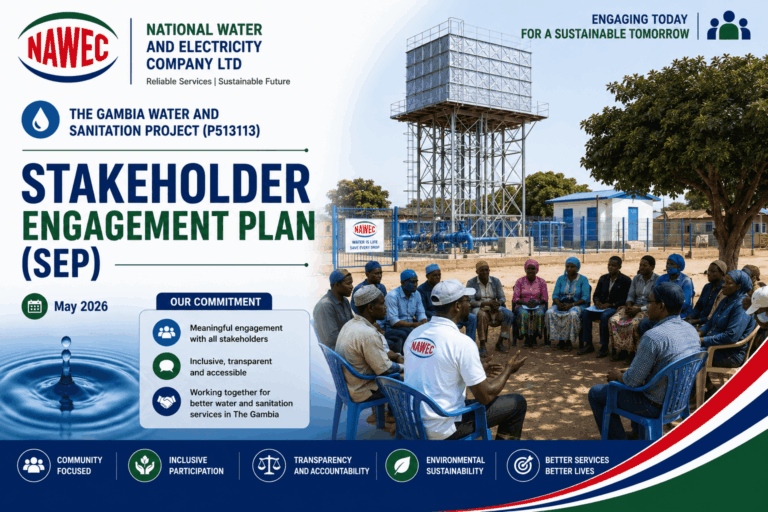
In fulfilment of its commitment to inclusive governance and transparent project delivery, NAWEC discloses the final Stakeholder Engagement Plan (SEP) for the World Bank–financed Gambia Water and Sanitation Project — inviting communities, customers, and partners to engage with and shape the process.
The National Water and Electricity Company (NAWEC), through its Project Implementation Unit (PIU), is pleased to publish the final Stakeholder Engagement Plan (SEP) for the Gambia Water and Sanitation Project (GWASAP, P513113), financed by the World Bank’s International Development Association. This document defines how NAWEC will communicate, consult, and respond to all communities, customers, civil society organisations, and partners throughout the project lifecycle.
The project addresses a critical and growing challenge: NAWEC currently produces 147,000 m³ of water per day, while peak daily demand stands at approximately 252,000 m³ — a daily deficit of 105,000 m³ that risks deepening further due to climate-driven droughts and rapid urbanisation. An estimated 45% non-revenue water (NRW) rate compounds this gap. This project is designed to close it, building infrastructure that is resilient, inclusive, and sustainable.
“The overall objective of this Stakeholder Engagement Plan is to define for NAWEC a strategy for stakeholder engagement, including public information disclosure and consultation throughout the entire Gambia Water and Sanitation Project life cycle — ensuring that all people can raise concerns, provide feedback, or make complaints about the project.”
What This Project Will Deliver
The Gambia Water and Sanitation Project is structured across five components with a total investment envelope of US$30 million, addressing water supply, sanitation, sector reform, and emergency resilience.
Where This Project Will Operate
The project covers multiple zones across the Greater Banjul Area and rural regions, each with tailored engagement approaches to reflect the different communities and works involved.
Who This Plan Is For
- Households near construction sites, roads, and infrastructure corridors
- Land and business owners in project areas
- Project workers and contractor employees
- Communities near wastewater and water supply works
- Ministry of Petroleum, Energy and Mines (MOPEM)
- Ministry of Health — WASH Coordination Unit
- National Environment Agency (NEA)
- Regional Governors, Area Councils, District Chiefs
- Village Development Committees (VDCs)
- Women’s associations and youth organisations
- Religious leaders and community elders
- NGOs, CSOs, and the Gambia Press Union
- Water and sanitation construction contractors
- Primary suppliers and desludging operators
- World Bank Task Team
- EIB, AFD, SFD, and EU partner organisations
Special Protections for Vulnerable Groups
The SEP recognises that certain groups face barriers to participation — including literacy, mobility, geography, and social norms — and commits to targeted engagement, accessible formats, female-led sessions for women and girls, sign language interpretation, and transportation assistance for those with disabilities.
Vulnerable and Disadvantaged Groups Covered by This Plan
- Female-headed households
- People with disabilities
- Women in agriculture or petty trade
- Elderly and illiterate persons
- Young girls and child vendors
- Families from ethnic minorities
- Migrant workers
- Youth and persons living with HIV/AIDS
How NAWEC Will Engage You
How to Raise a Concern or Complaint
NAWEC is committed to resolving all concerns fairly, quickly, and confidentially. The Grievance Mechanism is free of charge for all complainants, accepts anonymous submissions, and guarantees that no complainant will face retaliation of any kind for raising a concern.
Your Voice Matters — Share Your Views
NAWEC and the World Bank are committed to ensuring that the Gambia Water and Sanitation Project reflects the needs and aspirations of every community it serves. Whether you are a household in a project area, a community leader, a civil society organisation, a business, or simply a member of the public — you have a right to be heard. Read the full SEP and reach out through any of the channels above. For general project enquiries, contact NAWEC at communications@nawec.gm or visit NAWEC Headquarters, 53 Mamadi Maniyang Highway, Kanifing, Banjul.