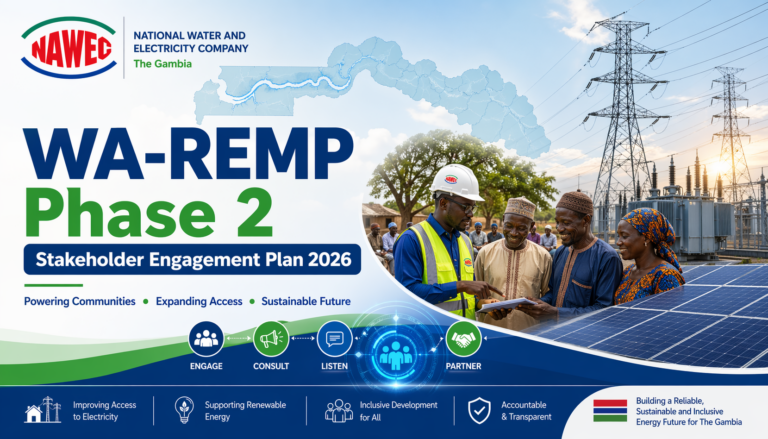
In fulfilment of its commitment to transparency, community inclusion, and responsible project delivery, NAWEC discloses the final Stakeholder Engagement Plan (SEP) for the World Bank–financed WA-REMP Phase 2 — inviting all affected communities, customers, and partners to engage with the process.
The National Water and Electricity Company (NAWEC), through its Project Implementation Unit (PIU), is pleased to publish the final Stakeholder Engagement Plan (SEP) for the WA-REMP Phase 2: Regional Electricity Access and Generation Support Project (P515184), financed by the World Bank’s International Development Association.
The SEP is a foundational document that defines how NAWEC will communicate with, consult, and respond to all communities, customers, civil society organisations, and partners throughout the project’s life. It reflects NAWEC’s commitment to transparent governance and its obligation — under the World Bank’s Environmental and Social Standard 10 (ESS10) — to ensure that no community is left behind in the decisions that affect them.
The Gambia’s electricity access rate has grown from 60 percent in 2018 to 74 percent in 2024, and is projected to reach 90 percent by 2026. This project is designed to go further — targeting the electrification of the remaining 565 unelectrified communities and the densification of partially electrified areas, to achieve universal electricity access by 2030.
What This Project Will Deliver
“The overall objective of this Stakeholder Engagement Plan is to define for NAWEC a strategy for stakeholder engagement, including public information disclosure and consultation throughout the entire project life cycle — ensuring that people can raise concerns, provide feedback, or make complaints about the project and any related activities.”
Who This Plan Is For
The SEP covers all stakeholders of the project — those directly affected by activities, those with an interest in outcomes, and those who may be disproportionately impacted if not specifically engaged. Every individual and group — whether a household in an unelectrified community, a government ministry, a local contractor, or a civil society organisation — has a defined role in this plan.
- Households in communities receiving new electricity connections
- Land and business owners near infrastructure sites
- Workers and their families
- Communities near substations, lines, and access roads
- Ministry of Petroleum, Energy and Mines (MOPEM)
- National Environment Agency (NEA)
- Department of Forestry & Department of Labor
- Regional Governors, Area Councils, District Chiefs
- Village Development Committees (VDCs)
- Women’s associations and youth organisations
- Religious leaders and community elders
- NGOs, CSOs, and the Gambia Press Union
- Construction contractors and sub-contractors
- Primary suppliers and engineering firms
- World Bank Task Team
- ECOWAS Regional Coordination Unit (RCU)
Special Protections for Vulnerable Groups
The SEP recognises that certain groups may face barriers to participation or may be disproportionately affected by project activities. NAWEC is committed to ensuring that these groups are actively engaged, not merely consulted, through targeted outreach, accessible communication formats, safe consultation spaces, and dedicated facilitation.
Vulnerable and Disadvantaged Groups Covered by This Plan
- Female-headed households
- People with disabilities
- Women engaged in agriculture or petty trade
- Elderly and illiterate persons
- Young girls and child vendors
- Families from ethnic minorities
- Migrant workers
- Youth and persons living with HIV/AIDS
How NAWEC Will Engage You
NAWEC will use a wide range of engagement methods throughout the project to ensure that all stakeholders — including those with limited literacy or mobility — can participate meaningfully. Engagement will be ongoing throughout all project stages, not just during preparation.
How to Raise a Concern or Complaint
NAWEC takes complaints seriously. The project maintains a structured Grievance Mechanism (GM) designed to receive, process, and resolve concerns from any individual or community affected by project activities — fairly, confidentially, and within defined timeframes. Submitting a complaint will never result in any penalty or disadvantage to the complainant.
Your Voice Matters — Share Your Views
NAWEC and the World Bank are committed to ensuring that the WA-REMP project reflects the needs and concerns of all communities it serves. If you are a resident, customer, community leader, civil society representative, or anyone with an interest in this project, we encourage you to read the full Stakeholder Engagement Plan and share your feedback through any of the contact channels above.
For general enquiries about the project, contact the NAWEC Communications team at communications@nawec.gm or visit NAWEC Headquarters, 53 Mamadi Maniyang Highway, Kanifing, Banjul.